How Smart Are Kangaroos? Amazing Facts You Didn’t Know

Did you know that kangaroos can actually recognize human faces? While these iconic Australian marsupials are often associated with their jumping prowess, their intelligence is equally fascinating. In this article, we’ll explore how smart are kangaroos and uncover the surprising cognitive abilities that set them apart from other animals.
Understanding their intelligence not only enriches our appreciation of these creatures but also sheds light on the complexities of animal behavior in general.
How Smart Are Kangaroos?
Kangaroos are often underestimated when it comes to intelligence, but recent studies reveal surprising cognitive abilities. Researchers have discovered that these marsupials exhibit problem-solving skills and can learn from one another, showcasing a level of social intelligence not typically associated with their kind.
For instance, kangaroos can navigate complex environments and adapt their behaviors based on the presence of predators, suggesting a capacity for situational awareness that goes beyond mere instinct.
Their communication methods are intriguing. Kangaroos use a variety of vocalizations and body language to convey messages, indicating a sophisticated social structure. Observations of kangaroo groups demonstrate that they can recognize each other, forming bonds that enhance their survival.
Read also: How Strong Are Kangaroos?
What Makes Kangaroos Smart Animals?
Kangaroos display a remarkable adaptability that highlights their intelligence in various environments. For instance, they exhibit complex social behaviors, often forming small groups that enhance their survival chances.

This social structure not only fosters intricate communication but also allows them to share knowledge about food sources and threats, showcasing emotional intelligence in their interactions.
Kangaroo intelligence lies in their ability to solve problems. Research has shown that these animals can navigate obstacles in their paths, employing creative thinking to find the best route to safety or sustenance.
Their keen memory helps kangaroos remember locations of water sources, which is crucial in the harsh landscapes of Australia.
When pondering how smart kangaroos truly are, it’s clear that their cognitive skills extend beyond basic survival; they represent a unique blend of instinct and intelligence that captivates researchers and wildlife enthusiasts.
Related: Top Animals without Tails
How Do Kangaroos Communicate with Humans?
Kangaroos exhibit a remarkable level of intelligence, often surprising us with their ability to communicate with humans in nuanced ways. Their body language is particularly telling; for instance, a kangaroo’s posture, whether it stands upright or crouches, can indicate levels of comfort or stress.
Observing these non-verbal cues allows us to gauge their feelings and intentions, revealing an innate connection between humans and these fascinating marsupials.
They also use vocalizations to enhance their communication. When startled, they might emit a series of grunts or growls, signaling distress not just to their peers but also to humans in proximity. This responsiveness highlights how smart kangaroos actually are, as they seem to have an understanding of their environment and the beings within it.
They have been observed recognizing individual humans, responding differently based on past interactions. This ability fosters a unique bond, making each encounter special.
Through playful interactions or cautious retreats, kangaroos teach us not only about their world but also about the power of empathy, proving that communication transcends the boundaries of language.
Related: Animals with Small Ears
Kangaroos Socila Intelegence
Recent studies suggest that these marsupials possess a sophisticated understanding of social dynamics within their groups.
For example, kangaroos are known to use body language and vocalizations to communicate effectively, signaling danger or coordinating movements during foraging activities. This intricate form of communication not only showcases their cognitive abilities but also highlights their adaptability in responding to the nuances of their social environment.
Researchers have observed them engaging in cooperative behaviors, such as grooming and forming hierarchies, which indicate a complex social structure. This collaborative nature helps them navigate challenges like resource competition or predator threats, reinforcing the idea that their intelligence extends beyond mere instinct.
Outsmarting Predators with Cunning Strategies
Kangaroos, often celebrated for their agility and strength, possess a set of cunning strategies that allow them to outsmart predators.
One remarkable tactic involves their unique method of movement; when threatened, they employ erratic zigzag patterns while hopping, making it difficult for predators to predict their direction. This unpredictability is enhanced by their exceptional hearing and keen eyesight, allowing them to detect danger long before it approaches.
They showcase remarkable social intelligence. By staying in groups, they not only increase their collective awareness but also employ a “lookout” system where one or two individuals remain vigilant while others graze.
This cooperative behavior exemplifies how smart kangaroos are — not merely relying on physical prowess but leveraging teamwork to enhance survival.
By adopting these strategies, kangaroos demonstrate that intelligence in the animal kingdom often intertwines with survival instincts, changing the narrative around how cunningly they navigate their environment.
Related: Clumsy Animals in The World
Facts About Kangaroos
Kangaroos are not just iconic symbols of Australia; they are also fascinating creatures with remarkable intelligence. Studies have shown that these marsupials possess problem-solving skills on par with some mammals traditionally considered highly intelligent.
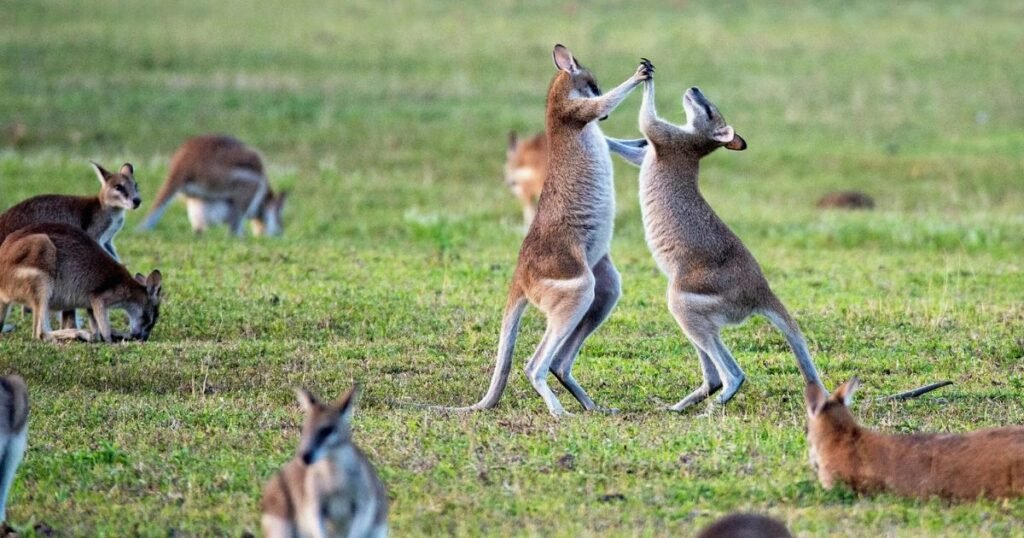
Kangaroos have been observed using teamwork to navigate obstacles and reach food, demonstrating not only their cognitive abilities but also their social behaviors.
They can hop atimpressive speeds—up to 35 miles per hour—thanks to their powerful hind legs. This unique mode of movement is economical, allowing them to cover vast distances in search of food and water. Interestingly, their ability to conserve energy while hopping makes them incredibly efficient travelers, adapting perfectly to the Australian landscape.
Studies of kangaroo communication highlight their capacity to distinguish between different calls, showcasing a level of social awareness that prompts the question: just how smart are kangaroos? Their diverse range of vocalizations and body language indicates a deep level of interaction among their groups, making them far more than just hopping herbivores.
Are Kangaroos Smarter than Fox?
When it comes to animal intelligence, the debate often narrows down to contrasting species, such as kangaroos and foxes.
Kangaroos may appear less cognitively advanced than their clever counterparts, yet recent research unveils surprising complexity in their behavior. For instance, kangaroos exhibit problem-solving skills and a capacity for social learning, essential traits that indicate a level of intelligence not to be underestimated.
Foxes are renowned for their cunning tactics and adaptability, particularly in urban environments. Their ability to navigate challenging landscapes and outsmart traps reveals a sophisticated understanding of their surroundings.
While foxes may excel in manipulation and opportunism, kangaroos display their own brand of intelligence through social structures and communication.
This difference adds rich layers to the discussion of animal smarts, leaving us to ponder whether the metrics of intelligence should always align with cunning survival strategies.
Read Also: Top 20 Animals Similar to Foxes
Conclusion
How smart are kangaroos? They are not just athletic and iconic representatives of Australia; they are also surprisingly intelligent animals.
Research has revealed their capacity for problem-solving and their impressive memory skills, which play crucial roles in their survival. Their social behavior showcases a level of communication and cooperation that enriches our understanding of animal intelligence.